Choosing between a Ridgid and a DeWalt shop vacuum in 2026 depends on specific needs, priorities, and existing tool ecosystems. Ridgid offers powerful suction and durable machines, often backed by a lifetime warranty, making them ideal for those prioritizing raw power and affordability. DeWalt excels with superior build quality, robust design, thoughtful features like quieter operation in its Stealthsonic series, and seamless integration for users already invested in their 20V Max platform.
What are Shop Vacuums and Why Do You Need One?
A shop vacuum, often called a wet/dry vac, is a specialized cleaning appliance engineered to handle tough debris and liquids that would overwhelm or damage a regular household vacuum. Unlike typical home vacuums designed for carpets and light dirt, shop vacuums feature powerful motors, durable construction, and large capacities to tackle the most challenging environments.
These workhorses find their place across a wide array of applications. In a home workshop, they’re perfect for sucking up sawdust, wood chips, and metal shavings generated by woodworking and metalworking projects. On construction sites, they effortlessly manage plaster dust, concrete debris, and scattered fasteners. Garages benefit from their ability to clean up automotive spills, dirt, and general grime. Even for unexpected household disasters like a burst pipe or an overflowing toilet, a wet/dry vac quickly becomes your best friend, capable of suctioning up large volumes of water.
The benefits of using a shop vacuum over a conventional household vacuum are numerous. They offer significantly more suction power, crucial for lifting heavy debris. Their robust tanks, often made from durable plastic or stainless steel, are built to withstand impacts and hold large quantities of both wet and dry messes without damage. Many models come with specialized attachments and filtration systems designed to handle fine dust, ensuring a cleaner and safer workspace.
Understanding Shop Vacuum Classifications
Shop vacuums come in various configurations, each designed to meet specific cleaning needs. Understanding these classifications is key to selecting the right model for your tasks.
By Power (Horsepower)
The power of a shop vacuum is primarily measured by its peak horsepower (HP). This figure indicates the maximum power the motor can generate.
- Under 5 HP: These are typically smaller, more portable units, often found in 2-6 gallon capacities. They are suitable for light-duty tasks like car detailing, small spills, or quick workshop cleanups.
- 5-6.5 HP: This range represents the mid-to-heavy-duty category. Vacuums here usually have 8-16 gallon tanks and offer a strong balance of power and capacity for most workshop, garage, and jobsite cleaning.
- Above 6.5 HP: These are generally the largest and most powerful machines, often with capacities of 16 gallons or more, designed for industrial applications or extensive professional use where maximum suction and continuous operation are required.
By Tank Capacity
|
Our Picks for the Best Shop Vacuum in 2026
As an Amazon Associate I earn from qualifying purchases.
|
||
| Num | Product | Action |
|---|---|---|
| 1 | Shop-Vac 5989305 Wet/Dry Vacuum, 5 Gallon, 4.5 Peak HP Stainless Steel Vacuum, 1.25 Inch Diameter x 7 Foot Hose, 6 Ft Cord Length, Ideal for Jobsite, Garage, Car & Workshop |

|
| 2 | Armor All VBV809 0901 8-Gallon 4.5 Peak HP Wet/Dry Vacuum with Detachable Blower, Orange |
|
| 3 | Shop-Vac 9522205 5 Gallon 5.5 Peak HP Hangup Wet/Dry Vacuum, 1.25 Inch Diameter x 18 Foot Hose, 6 Foot Cord, Wall Mount Included, Ideal for Garage, Workshop & Home |
|
| 4 | Stanley - SL18129 Wet/Dry Vacuum, 4 Gallon, 4 Horsepower, Stainless Steel Tank Silver+yellow |
|
| 5 | Shop-Vac 5985005 6 Gallon Wet/Dry Vacuum, 3.5 Peak HP, 1.25 Inch Diameter x 7 Foot Hose, 6 Foot Cord, Ideal for Home, Garage, and Workshop Cleaning |
|
| 6 | Armor All VO408S 0901 4 Gallon 3 Peak HP Stainless Steel Wet/Dry Vacuum, Orange |
|
| 7 | Kärcher Shop Vacuum WD 4, 5.3 Gal, 3.8 Peak HP, 33 ft Reach, Wet Dry Vacuum Cleaner, Heavy Duty, Blower Function, Crevice Tool, Floor Nozzle, Great for DIY Projects and Workshops |
|
| 8 | Vacmaster VF408 4 Gallon Wet/Dry Vacuum Cleaner with 2-Stage Motor |
|
| 9 | Vacmaster Wet/Dry Vacuum with Detachable Blower 6 Gallon 5 Peak HP-VBVB611PF 1101 |
|
| 10 | DEWALT DXV16PA 16 Gallon Poly Wet/Dry Vac/Acc, 6.5HP Shop Vacuum Wet/Dry for Jobsite/Workshop, Yellow |
|
The tank capacity, measured in gallons, dictates how much debris or liquid the vacuum can hold before needing to be emptied.
- Small (1-6 Gallons): Compact and highly portable, these are ideal for quick cleanups, vehicle interiors, or tight spaces. Their smaller footprint makes them easy to store.
- Medium (8-14 Gallons): The sweet spot for most DIY enthusiasts and light commercial users. These offer a good balance of capacity for regular workshop tasks without being overly cumbersome.
- Large (16+ Gallons): Designed for heavy-duty, prolonged cleaning sessions in large workshops, commercial settings, or construction sites, minimizing the frequency of emptying.
By Features (Wet/Dry, Fine Dust, Blower)
Modern shop vacuums are packed with features that enhance their versatility.
- Wet/Dry Capability: This is a standard feature, allowing the vacuum to handle both dry debris and liquids without damaging the motor. It typically involves a different filter for wet versus dry applications.
- Fine Dust Filtration: Many shop vacs offer advanced filtration, including HEPA-rated filters, which can capture 99.97% of particles down to 0.3 microns. This is essential for health and safety when working with materials like drywall dust, concrete dust, or fine wood dust.
- Blower Function: A common and incredibly useful feature, allowing you to detach the hose and connect it to the exhaust port, transforming the vacuum into a powerful blower. This is handy for clearing sawdust off workbenches, blowing leaves, or drying wet surfaces.
By Power Source (Corded, Cordless)
Your power source can significantly impact a vacuum’s portability and power.
- Corded: The most common type, offering consistent, powerful suction for extended periods. They require access to an electrical outlet but eliminate concerns about battery life.
- Cordless: Ideal for maximum portability and cleaning in areas without immediate power access. These run on rechargeable batteries, often part of a larger tool ecosystem (like DeWalt’s 20V Max or Ridgid’s 18V platforms). While convenient, they may offer less sustained power or shorter runtimes compared to their corded counterparts, particularly for heavy-duty tasks.
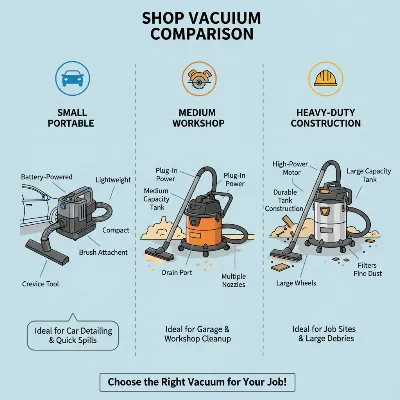 Illustration comparing different types of shop vacuums based on size and features in a workshop setting
Factors to Consider When Buying a Shop Vacuum (Buying Guide)
Choosing the right shop vacuum involves balancing your specific needs with various features and specifications. Here’s a detailed buying guide to help you make an informed decision.
Power (HP and Airflow/CFM)
While peak horsepower (HP) gives an indication of raw motor strength, it’s not the only metric for performance. Airflow, measured in Cubic Feet per Minute (CFM), determines how much air the vacuum can move, which is critical for picking up light debris like sawdust. Water lift (or sealed suction, measured in inches of water) indicates the vacuum’s ability to lift heavy objects or liquids. A good shop vacuum offers a strong balance of both CFM and water lift, ensuring it can handle a variety of messes effectively. For general workshop use, a unit with 5.0 to 6.5 peak HP is often sufficient.
Tank Capacity
Consider the scale and frequency of your cleaning tasks. A smaller 4-6 gallon vac is excellent for vehicle interiors or quick spills, offering superior portability. For a busy home workshop or garage, an 8-12 gallon model provides a good balance of capacity and maneuverability. If you’re a professional contractor or tackle large-scale projects regularly, a 14-16 gallon (or larger) capacity will reduce the need for frequent emptying, saving time and effort.
Filtration System
The quality of the filter directly impacts the cleanliness of your air, especially when dealing with fine dust. Standard filters are adequate for general debris, but for fine particles like drywall dust, concrete, or allergens, a HEPA-rated filter is highly recommended. These filters capture microscopic particles, improving air quality and protecting your health. Always check if the filter is washable and reusable, and if changing filters for wet versus dry applications is a tool-free process, as this can greatly enhance convenience.
Noise Level
Shop vacuums, by nature, can be noisy due to their powerful motors. Measured in decibels (dB), this factor is important if you work in shared spaces or for extended periods. Some manufacturers, like DeWalt with its Stealthsonic series, prioritize quieter operation. While a completely silent shop vac is a pipe dream, models in the 80-90 dB range are generally more tolerable than those exceeding 95 dB. Investing in hearing protection is always a wise choice when operating these machines.
Durability and Build Quality
A shop vacuum is an investment, so look for robust construction. Polypropylene (poly) tanks are common and durable, resisting dents and rust. Stainless steel tanks offer maximum durability and a premium feel. Inspect the latches, hose, and wheels—they should feel sturdy and well-made. A high-quality hose that resists kinking, cracking, and tearing is vital for long-term use. Manufacturers like Ridgid and DeWalt are known for their rugged tool construction.
Additional Features
- Hose and Cord Management: Good onboard storage for hoses, cords, and attachments keeps everything organized and prevents tripping hazards. Features like locking hoses prevent accidental disconnections.
- Blower Port: The ability to convert your shop vac into a blower adds significant versatility, useful for clearing debris from surfaces or drying areas.
- Drain Plug: For wet cleanups, a conveniently located drain plug makes emptying liquids much easier than tipping the entire heavy tank.
- Mobility: Large, smooth-rolling casters (preferably 360-degree swivel wheels) enhance maneuverability, especially for larger units.
Price and Warranty
Shop vacuums vary widely in price, from under $100 for basic models to several hundred dollars for professional-grade units. Determine your budget but that investing in a higher-quality unit often pays off in durability and performance. Both Ridgid and DeWalt offer excellent warranties; Ridgid is notably known for its lifetime warranty on many of its tools, including some shop vacuums, which can provide significant peace of mind.
Ridgid vs. DeWalt: A Head-to-Head Comparison
When comparing Ridgid and DeWalt shop vacuums, you’re essentially looking at two brands that embody professional-grade performance and durability, but with slightly different philosophies that cater to varying user preferences. Ridgid, often associated with Home Depot, has built a reputation for powerful, robust, and generally budget-friendly options, frequently offering excellent value. DeWalt, a staple on professional job sites, emphasizes rugged build quality, innovative features, and often integrates its vacuums into its broader cordless tool ecosystem, though it also offers strong corded models.
Here’s a comparison of some key aspects:
| Feature/Brand | Ridgid | DeWalt |
|---|---|---|
| Philosophy | High power, durability, value, lifetime warranty (on many) | Rugged build, innovative features, system integration (cordless), reliable performance |
| Typical HP Range | 3.5 – 6.5 Peak HP | 2 – 6.5 Peak HP |
| Capacity (Gal) | 4 – 16+ Gallons | 4 – 16 Gallons |
| Key Features | “Tug-A-Long” locking hoses, Qwik Lock filter system, excellent accessory storage, blower function, drain plugs. | Durable construction, 360-degree casters, onboard storage, quieter “Stealthsonic” models, some cordless/corded options, blower function, drain plugs. |
| Hose Quality | Generally good, but some users note stiffness or potential for splitting on older/smaller models; smooth interior to prevent clogs. | Robust and kink-resistant on many models, but some models have stiff hoses; specific 1-7/8″ hose size may require adapters for dust collection. |
| Portability | Good for compact models, larger units might have 2 fixed rear wheels making maneuverability slightly less agile than 4 swiveling casters. | Excellent, especially for compact models designed for grab-and-go; 360-degree casters on many models enhance movement. |
| Noise Level | Can be loud, though some larger NXT models feature patented sound reduction technology. | Generally competitive, with “Stealthsonic” models specifically designed for quiet operation (as low as 81 dB). |
| Filtration | Standard and HEPA options, easy filter changes. | Standard and HEPA options, durable cartridge filters. |
| Warranty | Lifetime warranty on many models. | Typically 3-year limited warranty. |
| Price Range | Generally budget-friendly to mid-range. | Mid-range to premium, reflecting robust build and brand name. |
| Pros | Exceptional suction power for the price, durable, great value, user-friendly filter system, often highly rated for overall performance. | Superior build quality, reliable, quieter options, seamless integration with other DeWalt tools if you’re already in their ecosystem. |
| Cons | Hose durability issues on some models, can be noisy, some larger models less nimble. | Cordless models may have limited power/runtime; replacement bags can be harder to find for some specific models; proprietary hose sizes can require adapters. |
“Choosing between Ridgid and DeWalt often comes down to prioritizing raw power-to-price ratio versus refined design and system integration. Both offer exceptional tools, but their strengths lean in slightly different directions.” – Admin, ReviewEliza.com, Shop Vacuum Expert
Top Ridgid Shop Vacs for 2026
Ridgid continues to be a go-to brand for many, offering powerful suction and robust construction. Here are some of their standout models for 2026.
Ridgid 12-Gallon 5.0 Peak HP NXT Wet/Dry Shop Vacuum
This model is frequently cited as a top performer and “best overall” by many experts. It boasts a powerful 5.0 peak horsepower motor, providing impressive suction for both wet and dry messes. The 12-gallon capacity strikes an excellent balance for most workshop and garage tasks, allowing for extended use without constant emptying. Users appreciate its heavy-duty locking hose (Tug-A-Long), which resists accidental disconnections, and the Qwik Lock filter fastening system makes filter changes tool-free and quick. Its robust poly drum ensures durability, and a convenient drain plug simplifies liquid disposal. While some large models can be a bit less agile than those with four casters, its overall power and value are undeniable.
- Pros: Exceptional suction power, durable construction, easy filter changes, good capacity for general use, competitive price, often comes with useful accessories.
- Cons: Some reports of hose stiffness; larger size might be less portable for very tight spaces.
- Ideal for: DIY enthusiasts, home workshops, and light commercial users seeking strong, reliable performance and great value.
Ridgid 50313 4000RV 4-Gallon Portable Wet/Dry Shop Vacuum
For those prioritizing portability and a compact footprint, the Ridgid 4-gallon model is a strong contender. Despite its smaller size, it still packs a respectable 5.0 peak horsepower motor, making it surprisingly powerful for its class. It’s perfect for car detailing, cleaning up small spills, or quick workshop touch-ups. Features often include a long power cord for extended reach, and onboard accessory storage to keep nozzles and wands organized. Its compact design and lighter weight make it easy to carry around. However, some users have noted the hose could be more durable.
- Pros: Highly portable, compact design, strong suction for its size, budget-friendly, long power cord.
- Cons: Hose durability can be a concern for some users; smaller capacity means more frequent emptying for larger jobs.
- Ideal for: Car cleaning, small apartment or garage cleanups, and anyone needing a highly portable and affordable solution.
Ridgid 16-Gallon 6.5 Peak HP NXT Wet/Dry Shop Vacuum
When maximum capacity and power are the priority, the 16-gallon, 6.5 peak HP Ridgid NXT model steps up. This beast is designed for heavy-duty cleanups on job sites or in large workshops. Its formidable motor generates significant airflow (up to 184 CFM on some models), making quick work of large debris like wood chips and drywall. A notable feature on some large Ridgid models is the detachable blower, allowing the motor to be removed and used as a standalone blower—essentially two tools in one. It also typically features excellent onboard storage for all accessories and a durable drum built to last.
- Pros: Extreme suction power, very large capacity, dual-function (vacuum and detachable blower on some models), built for tough conditions.
- Cons: Large and heavy, less maneuverable in tight spaces, can be loud during operation.
- Ideal for: Professional contractors, large woodworking shops, and users who require maximum power and capacity for extensive cleaning tasks.
Top DeWalt Shop Vacs for 2026
DeWalt’s commitment to job site toughness and user-friendly design shines through in their shop vacuum lineup. Here are some of their top models for 2026.
DeWalt 10-Gallon 5.5 Peak HP Wet/Dry Shop Vacuum
Often lauded as a “best overall” choice in various reviews, DeWalt’s 10-gallon shop vacuum is a workhorse known for its reliable and powerful cleaning performance. Equipped with a 5.5 peak horsepower motor, it delivers serious suction that handles both wet and dry messes with ease. Reviewers frequently highlight its ease of use, including smooth-rolling 360-degree casters and an accessible on/off switch. The 20-foot power cord provides excellent range, and an onboard accessory pouch helps keep attachments organized. Its robust build quality ensures it can withstand the rigors of a demanding environment.
- Pros: Powerful and effective cleaning, excellent reliability and build quality, easy to operate, good cord length and storage, generally less irritating noise than some competitors.
- Cons: Cord can still be a bit cumbersome; some users desire more integrated hose storage.
- Ideal for: General workshop use, garage cleanups, and DIYers who value consistent performance and DeWalt’s trusted durability.
DeWalt DXV04T 4-Gallon Portable Shop Vacuum
The DeWalt DXV04T is a compact powerhouse, often praised for its “toolbox” design, making it incredibly portable and easy to carry to any job. Despite its small 4-gallon capacity, it features a strong 5.0 peak horsepower motor, capable of tackling significant wet and dry debris. Its portability makes it an excellent choice for cleaning vehicles, small spill containment, or quick touch-ups. The expandable hose offers good reach, and onboard accessory storage is a thoughtful detail for keeping attachments handy. While finding specific replacement bags might occasionally be a minor challenge, its convenience and power for its size are exceptional.
- Pros: Extremely portable, compact and sturdy design, powerful for its size, good onboard accessory storage, versatile for small tasks.
- Cons: Limited capacity for larger jobs; specialized bags might be harder to source; shorter hose on some models.
- Ideal for: Mobile professionals, car detailing, small home projects, and those who need a truly portable shop vacuum.
DeWalt Stealthsonic Quiet 12-Gallon Wet/Dry Shop Vacuum
For users who prioritize a quieter working environment without sacrificing power, the DeWalt Stealthsonic series is a major upgrade. The 12-gallon model stands out by significantly reducing noise levels—often operating as low as 81 dB—allowing for conversation or working without excessive ear protection. This is achieved through optimized airflow and motor design. Beyond its quiet operation, it offers robust suction, a durable poly tank, and typically includes a high-quality hose that resists kinking. It’s an excellent choice for workshops where noise can be a significant concern.
- Pros: Exceptionally quiet operation, strong suction power, large capacity, durable construction, high-quality hose.
- Cons: Can be a higher price point due to specialized quiet technology; still a large unit to store.
- Ideal for: Users in shared workspaces, home workshops, or anyone who values a quieter cleaning experience without compromising performance.
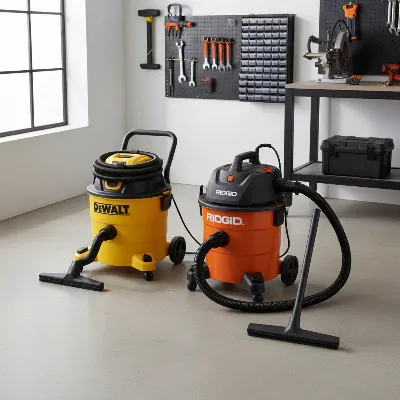 Two shop vacuums, one Ridgid and one DeWalt, side-by-side in a clean workshop, highlighting their design differences and professional appearance.
Tips for Using and Maintaining Your Shop Vacuum
To ensure your shop vacuum delivers peak performance and a long lifespan, proper usage and maintenance are crucial.
How to Use Your Shop Vacuum Safely and Effectively
- Read the Manual: Always start by familiarizing yourself with your specific model’s instructions.
- Choose the Right Filter: Use a dry filter for dry debris and remove it for wet pick-up (or use a specialized wet filter/foam sleeve if recommended). A clogged or incorrect filter significantly reduces suction.
- Secure Connections: Ensure the hose and all attachments are securely locked in place to prevent loss of suction or accidental disconnections.
- Empty Regularly: Don’t wait for the tank to be overflowing, especially with liquids. A full tank reduces performance and can make the unit heavy and difficult to maneuver or empty.
- Mind the Cord: Be aware of the power cord’s placement to avoid tripping hazards or accidental damage. Use an appropriately rated extension cord if needed.
- Wear PPE: Always use appropriate personal protective equipment, including eye protection, hearing protection, and a dust mask (especially for fine dust), when operating a shop vacuum.
How to Clean and Maintain Your Shop Vacuum to Extend its Lifespan
- Clean/Replace Filters Regularly: This is perhaps the most critical maintenance task. For dry filters, tap them clean or use compressed air. Washable filters should be cleaned according to manufacturer guidelines. Replace filters when they are worn, damaged, or can no longer be effectively cleaned.
- Inspect Hose and Attachments: Periodically check the hose for cracks, tears, or blockages. Clear any obstructions with a long, flexible tool. Ensure attachments are clean and free of debris.
- Empty and Clean the Tank: After each use, especially wet pick-ups, empty and rinse the tank thoroughly to prevent mold, mildew, or unpleasant odors. Allow it to air dry completely before storage.
- Check Motor and Fan: Listen for unusual noises. If you notice a reduction in suction or strange sounds, inspect the motor area and fan for obstructions. For complex issues, consult a qualified technician.
- Proper Storage: Store your shop vacuum and all accessories in a clean, dry place, protecting it from extreme temperatures and physical damage. Good onboard storage systems help keep everything together.
Common Issues and How to Fix Them
- Loss of Suction Power:
- Solution: Check for a clogged hose or attachments. Ensure the filter is clean and properly seated. Verify the tank isn’t overly full or that the lid is securely latched.
- Motor Overheating/Shutting Down:
- Solution: This is often a protective measure. Turn off and unplug the vacuum, allowing it to cool for at least 30 minutes. Ensure filters are clean and airflow isn’t restricted. Avoid prolonged, heavy use without breaks.
- Water Leaking:
- Solution: Inspect the drum for cracks or damage. Ensure all seals and gaskets are in place and not worn out. Confirm the drain plug is securely closed. The tank might be too full.
- Unusual Noises:
- Solution: Check for debris caught in the impeller (fan) or motor. If the noise persists after clearing any obstructions, it might indicate a motor issue requiring professional service.
Conclusion
Deciding between a Ridgid and a DeWalt shop vacuum in 2026 ultimately comes down to your specific needs, priorities, and existing tool ecosystem. Ridgid consistently offers incredible value, powerful suction, and durable machines often backed by a lifetime warranty, making them a fantastic choice for those prioritizing raw power and affordability. DeWalt, on the other hand, impresses with its superior build quality, robust design, thoughtful features like quieter operation in its Stealthsonic series, and seamless integration for users already invested in their 20V Max platform.
If you’re seeking maximum power and capacity at a competitive price, often with the added benefit of a lifetime warranty, Ridgid’s NXT series, particularly the 12-gallon or 16-gallon models, will serve you exceptionally well. If you value refined engineering, quieter operation, and perhaps the convenience of a portable, battery-powered option that integrates with your other professional-grade tools, DeWalt’s diverse lineup, from the portable DXV04T to the quiet Stealthsonic, is hard to beat.
Both brands are champions in their own right, delivering reliable performance that will improve your cleaning routine. Consider the types of messes you’ll tackle most often, your workspace environment, and how much portability you truly need. Which brand will be the ultimate dirt-devouring partner for your workshop or job site?
Frequently Asked Questions
What does “Peak Horsepower” mean for a shop vacuum?
Peak horsepower refers to the maximum power output a motor can achieve for a short burst. While it indicates raw potential, it doesn’t always reflect continuous operating power. For sustained performance, also consider airflow (CFM) and water lift, as these metrics provide a more complete picture of a vacuum’s suction capability for different types of debris.
Can I use a shop vacuum for household cleaning?
While a shop vacuum can pick up household messes, it’s generally not recommended as a primary home cleaning tool. Shop vacuums are designed for heavy-duty, often coarser debris and liquids, and lack the specialized brushes and delicate filtration systems optimized for carpets, upholstery, and fine household dust. Their larger size and noise level also make them less convenient for daily home use.
How often should I clean or replace my shop vacuum filter?
The frequency depends heavily on usage and the type of debris. If you’re frequently vacuuming fine dust (like drywall or concrete), you’ll need to clean or replace the filter more often—perhaps after every few uses. For general debris, checking it monthly or when you notice a drop in suction power is a good guideline. Always refer to your specific model’s manual for recommended intervals.
Are cordless shop vacuums as powerful as corded ones?
Cordless shop vacuums offer unparalleled portability, which is their main advantage. However, they typically don’t match the sustained power or runtime of comparable corded models, especially for large, heavy-duty tasks. Cordless options are excellent for quick cleanups, areas without power outlets, or integrating into an existing battery tool system, but corded models usually offer superior performance for extended, demanding jobs.
What is the advantage of a “Tug-A-Long” hose on Ridgid vacuums?
The “Tug-A-Long” hose feature on Ridgid shop vacuums is designed with a positive locking connection. This mechanism helps prevent the hose from accidentally disconnecting from the vacuum during use, which can be a common frustration with less secure hose designs. It ensures continuous suction and a more reliable cleaning experience, especially when maneuvering the vacuum around a busy workspace.
How to Use and Maintain Your Shop Vacuum
Proper usage and maintenance are crucial for ensuring your shop vacuum delivers peak performance and a long lifespan. Follow these steps to keep your wet/dry vac in top condition.
Always read your specific model's manual first. Choose the correct filter for dry or wet debris, ensuring it's clean and properly seated to maintain suction. Securely lock all hose and attachment connections to prevent disconnections and empty the tank regularly to avoid reduced performance.
This is the most critical maintenance task. Clean dry filters by tapping or using compressed air, and wash reusable filters according to manufacturer guidelines. Replace filters when they are worn, damaged, or can no longer be effectively cleaned to ensure optimal air quality and suction.
Periodically check the hose for cracks, tears, or blockages, clearing any obstructions with a flexible tool. After each wet use, empty and rinse the tank thoroughly to prevent mold and odors, allowing it to air dry completely before storage. Ensure attachments are clean and free of debris.
If suction is lost, check for clogs, a full tank, or an improperly seated filter. For motor overheating, turn off the vacuum and let it cool for 30 minutes, ensuring filters are clean. Water leaks often indicate drum damage or worn seals, while unusual noises may point to debris in the impeller.

My old shop vac finally died, and I needed something that could handle serious construction debris. The Ridgid has been fantastic. It’s got raw power for days and the large capacity means I’m not constantly emptying it. For anyone prioritizing affordability and sheer suction, this is the way to go. It’s a workhorse.
I’ve been a DeWalt guy for years, so when it came time for a new shop vac, the integration with my 20V Max platform was a huge selling point. This thing is a beast for cleaning up my workshop after woodworking projects. The suction is incredible, and it handles sawdust and wood chips without a problem. Definitely happy with this purchase.
I went with the Ridgid after reading about their lifetime warranty and powerful suction. It really does pull up everything, from drywall dust to spilled water in the garage. My only minor gripe is that it’s a bit louder than I expected, especially compared to some of the quieter models mentioned. Still, for the price and performance, it’s hard to beat.
I picked up a DeWalt Stealthsonic model hoping for that quieter operation, and while it is a bit less noisy than my old vac, it’s not as whisper-quiet as I imagined. It’s still a solid machine for my home garage, and the build quality feels really robust. Just wish the ‘stealth’ part was a little more pronounced.